Names and Fate
 James MacLeod
You ever have a feeling that names have an associated fate or destiny? Let's not get into occupational surnames like Smith and Cooper (these work the other way - folk were historically so named because of their trade).
I want to talk about something a little weirder.
Like the famous Edinburgh Michelin Star chef whose surname is Kitchin? Or Usain Bolt, the very fast sprinter? What about Wordsworth, the poet? The list goes on. Just type ‘aptronym examples’ in Google.
And guess what, the joke is multilayered; aptronym is an anagram/play on the word patronym, the route via which we traditionally get our surnames. Aptronym was coined by a bloke called Franklin P. Adams, a boringly not that aptronym.
There are loads of examples out there, and some are brilliant:
Marina Stepanova, a hurdler. This one is my favourite.
Thomas Crapper, a sanitary engineer. Funny for those who laugh at fart jokes (James Lord-McIntosh, I'm talking about you here.)
There's a theory behind this amusing phenomenon called Nominative Determinism (a term first coined back in the 90s in New Scientist in the Feedback Column).
But what do you do if you don't want to be a campanologist? Well, you could invent something new.
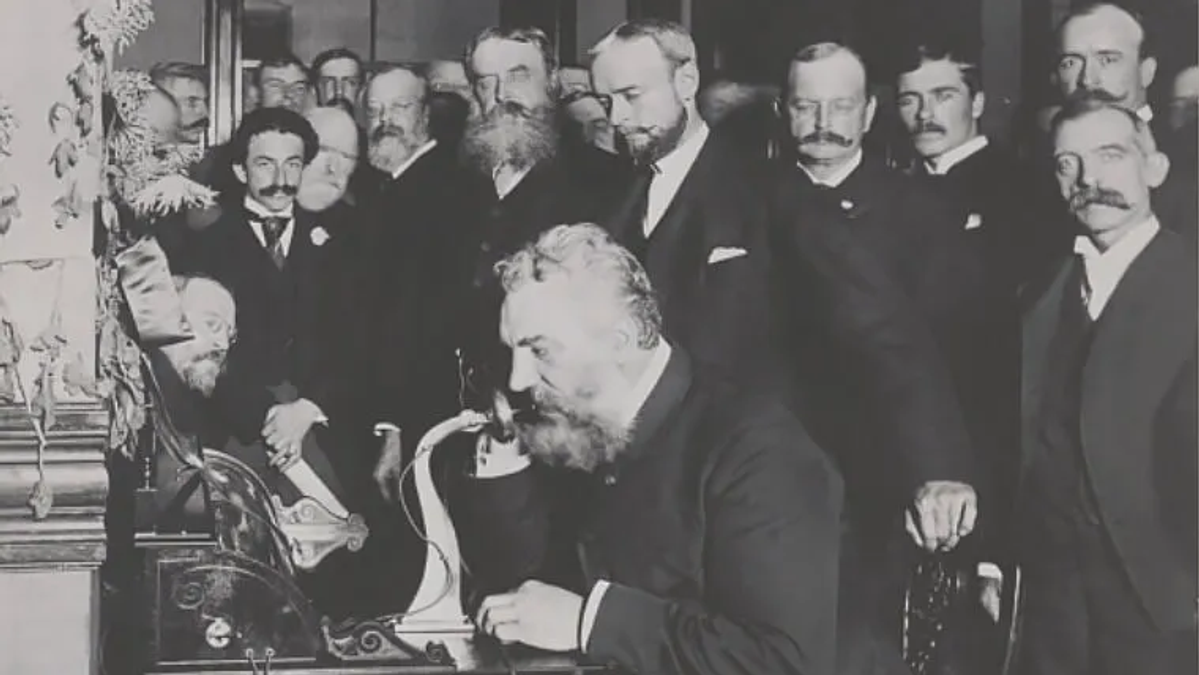
It's no surprise the inventor of the telephone had a very apt name too. Like it was meant to be. Is this ringing a bell for you? That's right, you know his name already. Alexander Graham Bell. A very famous Scottish-Canadian inventor.
In reality, he didn't consciously invent something that used bells. He was in fact drawn to acoustics in general as a subject after watching his mother struggle with worsening deafness from when he was 12 onwards (1859). The bells associated with his invention came later.
His interest and aptitude in acoustics shone quite early: In his attempts to continue to communicate with his mother, he would tap her hand in a cadence that reflected somewhat the conversations that surrounded them. He also began to heavily articulate and enunciate his speech, even pressing his mouth right up to his mother's forehead and speaking with the aim of somehow transferring the sound in a way his mother could hear. It worked according to her. And knowing how wonderful it is to hear my own children's voices, I am sure she was everlastingly thankful he kept trying.
We all know sound is vibration, but it was A. G. Bell (as he ended up styling himself in correspondence) who thought about using a pretty old school technology like the reed and a newer one like the telegraph to transmit sound across the medium of thin copper wires.
His thinking and experimentation led to a breakthrough in 1875 after a happy accident with the equipment. And from there, in a matter of short years, we got the Bell Telephone Company (Est. 1877) and it kinda went off from there.
This shows a significant level of perseverance on Bell's part; striving to improve connection between people for more than 28 years. I've no idea what Bell would think of our phones nowadays. Telephones that are more supercomputer than a means of simply hearing someone's voice across long distances. I think we've lost touch in some ways with what the telephone gave us; connection. Whilst we are now more "connected" than ever, that truer, more personal connection is being drowned out by the sheer volume of noise in this world of smartphones. And I get the irony of the fact I am adding to it with this blog. I am typing on a laptop though, so it isn't too on the nose.
But the point hear* is that maybe we should endeavour to quieten things down a bit. Stop bombarding the people around us with noise. Connect more directly with them, even in the workplace. Put effort into your communication, not by firing out reams of text to get your message or point out there, but by putting your energy instead into building real connection. That thing that inspired the inventor of the ancestor-tech of those damn things we spend too much time staring at every day.
So this blog is less a lesson and more a plea.
And names and destiny? Well, it was his mother, a Symonds, that drew him into acoutics in the first place, so maybe fate was all just coincidence in the end…
*Did you get my very funny homophone misuse here? Another pun with multiple layers; not just the use of the word phone, but the obvious use of the word hear. FYI, homophone is a word for a type of word (in this case meaning same sound different spelling and meaning), kinda like what aptronym and patronym are.